Table of Contents
- Emergency AC Repair Dallas: When to Call for Help
- AC Troubleshooting: What to Check Before Calling
- Air Conditioner Not Cooling? Common Causes and Fixes
- How 24/7 Emergency Service Works in Dallas and DFW
- AC Repair Cost: Understanding Emergency Pricing
- AC Repair vs. Replacement: Making the Right Choice
- Frequently Asked Questions
Last Updated: October 6, 2026
Emergency AC Repair Dallas: When to Call for Help
When an air conditioner quits in a Dallas summer, the house can become unsafe within hours. Emergency AC repair Dallas homeowners can count on means a licensed technician dispatched the same day, an upfront price before work begins, and a system running again before the heat turns dangerous.
Here is the part most guides skip: not every breakdown is an emergency, and treating every hiccup like one usually costs more than it should. The U.S. Department of Energy cooling guidance notes that cooling accounts for a large share of summer home energy use, which is exactly why a failing system deserves quick attention rather than guesswork.
Signs Your AC Problem Is an Emergency
An AC emergency is any failure that risks health, safety, or serious equipment damage: no cooling during extreme heat, a burning smell, water pooling around the unit, or a breaker that trips every time the system starts.
Watch for these red flags:
- No cool air when outdoor temperatures climb past 95°F, especially with infants, older adults, or pets at home
- A burning or scorched odor near the indoor unit or vents
- Buzzing, grinding, or repeated breaker trips
- Water leaking from the air handler or ceiling stains below it
Heat illness is a genuine risk, not a marketing line. The CDC heat and health resources explains how quickly heat exposure can affect vulnerable people.
Safe Homeowner Checks Before a Technician Arrives
Before a technician arrives, three safe checks can save a service call: confirm the thermostat is set to cool, inspect the air filter, and verify the outdoor unit has clear airflow.
- Check that the thermostat is on Cool and the set point is below room temperature
- Inspect the air filter; a clogged filter restricts airflow and can freeze the coil
- Clear leaves, grass, and debris at least two feet around the outdoor condenser
- Confirm the breaker for the AC is not tripped, then leave it alone if it trips again
Never open the electrical panel, remove the service cover, or pour water on the outdoor unit. Capacitors hold a dangerous charge even with power off, and refrigerant work is legally restricted to licensed technicians. A DIY repair here can injure you and void any equipment warranty.
AC Troubleshooting: What to Check Before Calling
AC troubleshooting starts with separating a control problem from a mechanical one. If the thermostat responds and the outdoor unit hums but the air stays warm, the issue is likely mechanical. If nothing responds, it may be power or the thermostat.
Run through this quick sequence:
- Confirm the thermostat batteries and display
- Check the air filter and replace it if it is visibly dirty
- Look for ice on the indoor coil or refrigerant lines
- Verify the outdoor unit is running and free of debris
- Reset the thermostat once, then wait ten minutes
If the system still blows warm air after those steps, stop and schedule service. Repeated resets can worsen a compressor problem, the most expensive part of the system.
Write down what you observed before calling: which unit ran, what sounds you heard, and whether the breaker tripped. Technicians diagnose faster with those details, and faster diagnosis often means a shorter visit and a smaller bill.
Air Conditioner Not Cooling? Common Causes and Fixes
An air conditioner not cooling usually traces back to one of five causes: a clogged filter, low refrigerant from a leak, a failing capacitor, a dirty condenser coil, or a thermostat fault.
| Symptom | Likely Cause | Typical Fix | Urgency |
|---|---|---|---|
| Warm air, unit runs | Low refrigerant or dirty coil | Leak test and recharge, coil cleaning | Same day |
| No airflow at vents | Clogged filter or blower fault | Filter change or blower repair | Same day |
| Breaker trips on start | Failing capacitor or compressor | Capacitor or compressor service | Emergency |
| Ice on lines | Restricted airflow or low charge | Thaw, airflow correction, recharge | Emergency |
| Unit silent | Power, thermostat, or contactor | Electrical diagnosis | Same day |
Dallas heat stresses every one of these components, and a system that struggles in July often fails outright in August. Catching a weak capacitor or slow refrigerant leak early is far cheaper than replacing a compressor later.
How 24/7 Emergency Service Works in Dallas and DFW
Around-the-clock AC service means a live dispatcher answers at any hour, a technician is assigned to your address, and you receive an arrival window before the truck rolls.
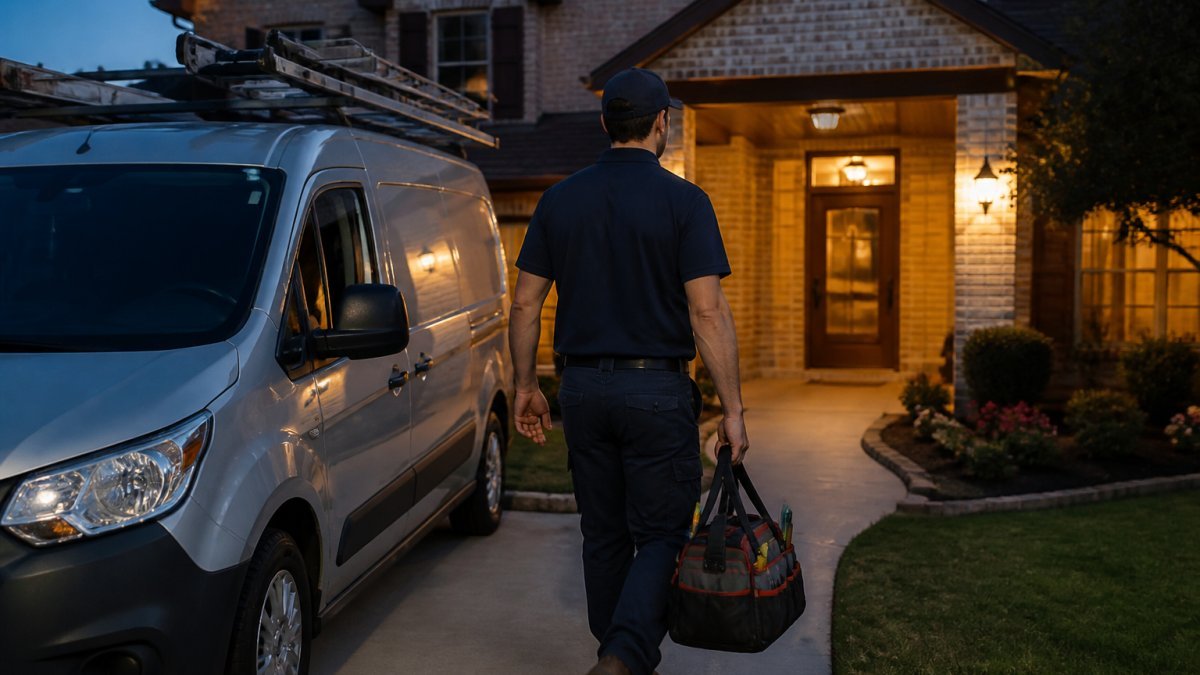
At Chrome Heating & Air Conditioning, our team has handled emergency HVAC calls across Plano, Dallas, and the DFW Metroplex for years. You call, we confirm the problem, and we give you a window.
Same-Day Scheduling and Fast Response Times
Same-day scheduling depends on when you call and where you are. Morning calls usually land an afternoon visit; late-night calls are triaged by severity, with no-cooling households and homes with vulnerable occupants first.
What affects your response time:
- Distance from the nearest available technician
- Severity of the problem as described on the call
- Time of day, since overnight calls draw from on-call crews
- Weather events, when a heat wave drives call volume up across the region
What Happens During an Emergency Service Visit
An emergency visit follows a set sequence: the technician confirms the complaint, inspects the system, diagnoses the fault, presents an upfront price, and only then begins the repair.
The typical visit looks like this:
- Arrival and intake: the technician reviews what you observed and checks the thermostat
- System diagnosis: electrical, refrigerant, and airflow checks on both indoor and outdoor units
- Written estimate: parts and labor quoted upfront, with options explained
- Repair: completed on the spot when parts are on the truck
- Verification: temperature drop measured at the vents before the technician leaves
The upfront price comes before the repair, not after. If a provider cannot tell you the cost before starting work, that is your signal to ask more questions before agreeing.
Protecting Your Household While You Wait
In a Dallas summer, the wait between your call and the technician’s arrival can matter as much as the repair itself. A few steps reduce risk:
- Move to the coolest part of the house. Lower floors and interior rooms without west-facing windows hold cooler air longer.
- Close blinds and curtains on sun-facing windows to cut radiant heat gain.
- Hydrate continuously. Offer water to children and older adults even if they are not asking.
- Use fans strategically. A box fan pulling air across a bowl of ice or a damp towel can lower the perceived temperature in a small room.
When to Shut the System Down and Wait for Help
Some symptoms mean the system should not be run again until a technician inspects it. Running it can turn a repair into a replacement, or create a safety hazard:
- Burning or scorched smell near the indoor unit or vents
- Smoke, sparking, or visible scorch marks at the unit or breaker
- Repeated breaker trips every time the system starts
- Water pooling around the air handler or ceiling stains below it
If you see any of these, turn the system off at the thermostat, leave the breaker alone, and call for service. Do not open panels or attempt a repair, capacitors hold a dangerous charge even with power off, and refrigerant work is legally restricted to licensed technicians.
Power Outages and Heat Waves
Extended outages during a heat wave are a different problem than a broken AC. If the whole neighborhood is dark, the issue is upstream of your equipment and no HVAC technician can fix it, but the household-safety steps above still apply. Once power returns, give the system a few minutes before deciding it has failed; some units have a built-in delay before the compressor restarts.
AC Repair Cost: Understanding Emergency Pricing
Emergency AC repair cost depends on the failed part, the labor involved, and whether the call falls outside standard hours. Estimates should always be presented in writing before work begins. Here is what shows up on the invoice.
The Line Items on an Emergency Invoice
A typical emergency repair quote is built from four or five line items, and each one moves the total:
- Diagnostic or trip fee, a flat charge to send a technician out and identify the fault. Many companies credit this toward the repair if you approve the work; some do not. Ask before you book.
- After-hours labor, nights, weekends, and holidays usually carry a higher hourly rate than a standard weekday visit. Confirm the rate on the phone rather than assuming.
- Parts, a run capacitor is one of the least expensive components; a compressor is one of the most expensive. The gap between them is the biggest swing in your total.
- Refrigerant, locating, repairing, and recharging a leak is a separate charge from the labor to find it.
What Actually Drives the Final Number
Two calls with the same symptom can land at very different totals. The variables that matter most:
- Which component failed. A capacitor swap is a quick, low-cost visit. A compressor replacement is a major repair that often pushes the conversation toward replacement.
- Whether the failure is isolated or systemic. A single bad part is a repair. A slow refrigerant leak stressing the compressor for months is a bigger job.
- Time of day. Overnight and holiday calls draw from on-call crews, and that premium shows in the rate.
- Parts availability. If the part is on the truck, the repair happens on the spot. If it must be sourced, expect a return visit, and possibly a second trip charge.
Questions to Ask Before You Approve Anything
A short phone script separates a transparent provider from one that surprises you at the door:
- Is the diagnostic fee credited toward the repair if I approve the work?
- Do after-hours rates differ from standard rates, and by how much?
- Will I get a written estimate before any work starts?
- Is the estimate a fixed price or an hourly estimate that can grow?
The answers tell you more than any advertisement. If a provider cannot give a written figure before starting, slow down.
A legitimate emergency provider quotes the price before the wrench turns, in writing, with parts and labor broken out. “We’ll figure it out when we get there” is not a pricing policy, it is a blank check.
Our upfront pricing means no hidden fees and no bait-and-switch quotes, and the diagnostic fee is credited toward the repair when you approve the work. Review the details on our pricing page before we start.
AC Repair vs. Replacement: Making the Right Choice
Repair wins when the system is under ten years old and the fault is isolated.
Use this decision framework:
- Under 10 years old, single fault: repair
- 10 to 15 years old, first major failure: repair, then plan for replacement
- Over 15 years old, compressor or coil failure: replace
- Two or more major repairs in three years: replace
A repaired system should hold. If the same problem returns within weeks, the underlying cause was never fixed. Chrome Heating & Air Conditioning backs its work with a 100% satisfaction guarantee, and our technicians are licensed.
A failing air conditioner in the middle of a Dallas summer is not something to wait out.
Frequently Asked Questions
How quickly can an emergency AC repair technician respond in Dallas?
Response times depend on your location, time of day, and current demand. Many companies offer same-day or next-day emergency scheduling, with some providing 24/7 availability. When you call, ask for an estimated arrival window and confirm any after-hours fees. In extreme heat, prioritize companies that dispatch technicians quickly to prevent health risks.
What should I do first if my AC stops working?
Check your thermostat settings and circuit breakers. Replace air filters if dirty. If the unit still doesn’t cool, turn it off to prevent damage and call for emergency AC repair. Avoid running a malfunctioning system, as it can worsen the problem. Safe homeowner checks like these can save time and money.
Is it safe to run my AC if it’s making unusual noises?
No. Unusual noises like grinding, squealing, or banging often indicate mechanical failure. Continuing to run the unit can cause further damage and may be hazardous. Turn off the system at the thermostat and breaker, then schedule emergency AC repair. A technician can diagnose the issue and prevent costly repairs.
What is the $5,000 rule for AC replacement?
The $5,000 rule is a general guideline: if the cost of repairing your AC multiplied by its age exceeds $5,000, replacement may be more cost-effective. For example, a 10-year-old unit needing a $600 repair equals $6,000, suggesting replacement. However, this is not absolute. Consider efficiency, warranty, and long-term savings when deciding between AC repair vs. replacement.