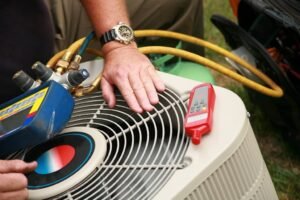
Does Your AC Need More Refrigerant in Summer? Signs of a Refrigerant Problem
Texas summers put your air conditioner under serious pressure. When temperatures climb, your AC may run for hours trying to keep your home comfortable. If the system is running but your house still feels warm, you may wonder whether it simply needs more refrigerant.
Refrigerant is essential to the cooling process, but an AC system normally does not “use up” refrigerant like fuel. If the refrigerant level is low, there is often a leak or another system problem that needs professional attention. The EPA recommends having leaks located and repaired rather than simply repeatedly topping off a leaking system.
For Texas homeowners considering their cooling options, understanding refrigerant problems can also help when comparing systems, including heat pump vs central AC, heat pump vs AC in Texas, and other HVAC choices.
Does an AC Need More Refrigerant in Summer?
Not necessarily.
A properly sealed air conditioner should maintain its refrigerant charge throughout its service life. Refrigerant circulates through the system and changes between liquid and gas as it absorbs and releases heat.
If your AC has low refrigerant, the issue is usually not simply that summer weather “used it up.” A leak, installation problem, damaged component, or previous service issue may be responsible.
Adding refrigerant without finding the underlying problem may provide temporary improvement, but the refrigerant can eventually escape again.
ENERGY STAR notes that properly charging an air conditioner or heat pump can improve efficiency and reduce the risk of system failure.
7 Signs Your AC May Have a Refrigerant Problem
1. Your AC Runs Constantly
One of the most noticeable signs is an AC that seems to run continuously without reaching the thermostat setting.
During an extremely hot Texas afternoon, longer cooling cycles are normal. However, if your system runs for hours and your home still isn’t comfortable, low refrigerant is one possible cause.
Other issues, such as poor airflow, dirty filters, duct problems, or an improperly sized system, can create similar symptoms.
2. Your Home Isn’t Cooling Properly
If your thermostat is set to 72°F but certain rooms remain warm, your system may not be transferring heat effectively.
Low refrigerant can reduce the system’s ability to absorb heat from indoor air. However, poor airflow and other mechanical problems can produce similar symptoms, so testing is necessary before assuming refrigerant is the cause.
3. Ice Appears on the AC
Seeing ice on the refrigerant lines, indoor coil, or outdoor unit can indicate a refrigerant problem.
It can also be caused by restricted airflow, such as a severely dirty filter or another airflow issue. Turning the system off and allowing it to thaw is safer than continuing to operate an AC that is visibly frozen.
If freezing repeatedly occurs, schedule professional HVAC diagnostics.
4. Your Energy Bills Suddenly Increase
An AC struggling to cool your home may run longer than normal, increasing electricity consumption.
A sudden increase in summer energy costs does not automatically mean your AC needs refrigerant. Changes in outdoor temperature, thermostat settings, insulation, duct leakage, and equipment efficiency can all affect energy usage.
However, if higher bills occur together with poor cooling or longer run times, it is worth having the system inspected.
5. You Hear Hissing or Bubbling Sounds
Unusual hissing or bubbling sounds near refrigerant lines or HVAC components may indicate a refrigerant leak.
Small leaks can sometimes be difficult to locate, so professional leak-detection equipment may be necessary.
6. There Is Oil Around Refrigerant Connections
Refrigerant leaks can sometimes leave oily residue around connections or components.
If you notice unusual residue around your outdoor condenser or refrigerant lines, avoid attempting to open or repair the system yourself. Refrigerant handling requires appropriate certification and equipment.
7. Your AC Needs Refrigerant Repeatedly
If you’ve had refrigerant added previously and the system needs another recharge months or even weeks later, that is a strong reason to investigate the system for a leak.
Repeatedly adding refrigerant without addressing the source can turn a relatively manageable repair into an ongoing expense.
Heat Pump vs Central AC: Does Refrigerant Matter?
If you’re researching heat pump vs central AC in Texas, remember that both types of systems use refrigerant as part of their cooling operation.
The major difference is that a heat pump can reverse its refrigeration cycle to provide heating as well as cooling. A conventional central AC system is designed primarily for cooling, while heating is typically provided by a separate furnace or electric heating system.
For homeowners researching heat pump or AC for Texas, factors such as heating needs, cooling performance, installation requirements, efficiency, and existing HVAC equipment should all be considered.
The same basic principle applies to refrigerant: neither system should routinely require refrigerant additions when the refrigeration circuit is properly sealed.
How Much Does Refrigerant Affect AC Performance?
Refrigerant charge is important because the system is designed to operate with a specific amount of refrigerant.
ENERGY STAR recommends ensuring that HVAC equipment has the proper refrigerant charge because correct charging supports comfort and efficiency.
That is why homeowners researching heat pump energy efficiency Texas or central AC vs heat pump energy efficiency should consider proper installation and maintenance—not just the equipment’s advertised efficiency rating.
Should You Just Add More Refrigerant?
Adding refrigerant may not solve the underlying problem.
The EPA specifically recommends that homeowners ask technicians to locate and repair leaks rather than simply “top off” leaking systems. Repairing the leak can help avoid repeated service calls and unnecessary refrigerant loss.
A professional HVAC technician may:
- Inspect the system.
- Check operating pressures and temperatures.
- Test the refrigerant charge.
- Search for possible leaks.
- Identify damaged components.
- Repair the underlying problem.
- Recharge the system according to manufacturer specifications.
- Verify that the system is operating correctly.
Refrigerant for stationary air-conditioning equipment is also subject to EPA Section 608 requirements, and homeowners should use appropriately certified technicians for refrigerant service.
Heat Pump Cost Texas vs. AC Replacement
If your AC is older and has a recurring refrigerant leak, repair may not always be the only consideration.
Homeowners comparing heat pump cost Texas, heat pump installation cost Texas, or central AC replacement cost Texas should look at the condition and age of the existing equipment, expected repair costs, efficiency, and long-term operating needs.
Likewise, someone searching is a heat pump worth it in Texas should consider whether they want one system capable of both heating and cooling.
There isn’t one HVAC solution that makes sense for every Texas home. Proper sizing, installation quality, insulation, ductwork, equipment condition, and household heating and cooling requirements all matter.
When Should You Call an AC Professional?
Call an HVAC professional if:
- Your AC blows warm air.
- The system runs continuously.
- Ice repeatedly forms on the indoor or outdoor unit.
- You notice unusual hissing sounds.
- You suspect a refrigerant leak.
- Your energy bills suddenly increase.
- Your AC repeatedly needs refrigerant.
- Your home isn’t reaching the thermostat temperature.
Don’t assume that every cooling problem means you need refrigerant. A professional diagnosis can determine whether the problem is refrigerant-related or caused by airflow, electrical components, ductwork, the compressor, thermostat, or another part of the system.
FAQs About AC Refrigerant Problems
How do I know if my AC needs refrigerant?
Poor cooling, unusually long run times, ice formation, and certain unusual sounds can indicate a refrigerant problem. However, these symptoms can have other causes, so professional testing is recommended.
Does an AC use refrigerant over time?
A properly sealed AC system should not normally consume refrigerant. If the refrigerant charge is low, a leak or system issue may need to be investigated.
Can I add refrigerant myself?
No. Refrigerant service for stationary HVAC equipment requires appropriate EPA Section 608 certification.
Is low refrigerant bad for an AC?
Yes. An incorrect refrigerant charge can reduce cooling performance and efficiency and may contribute to equipment problems. ENERGY STAR recommends verifying proper refrigerant charging during HVAC installation and service.
Should I repair a refrigerant leak or replace my AC?
That depends on the equipment’s age, condition, efficiency, repair cost, and the nature of the leak. An HVAC professional can evaluate the system and explain the available options.
Keep Your Texas AC Ready for Summer
A refrigerant problem can prevent your AC from delivering the cooling your home needs during the hottest part of the year. If your system is running longer than usual, blowing warmer air, freezing up, or repeatedly requiring refrigerant, don’t simply assume it needs another recharge.
Chrome Air Conditioning can help identify the cause of AC performance problems and determine whether your system needs repair, refrigerant service, or further evaluation.
If your AC isn’t keeping your Texas home cool, Chrome Air Conditioning is here. Call 469-252-0599.
Author: Chrome Heating & Air Conditioning | Plano, TX